
One VPN Login Without MFA Shut Down a Factory for 10 Days. Check Your Remote Access Before Monday
Japanese meter maker Osaki Electric says attackers got in through its VPN at 1:30 a.m. on a Sunday, most likely by guessing the password on an old account without multifactor sign-in. Two days later its servers were encrypted, production stopped, and stolen data showed up online. Here is how to check your own remote access this holiday weekend.
- ransomware
- vpn
- mfa
- remote-access
- firewall
- business-continuity
- downtime
- msp
- cybersecurity
- smb
- managed-it
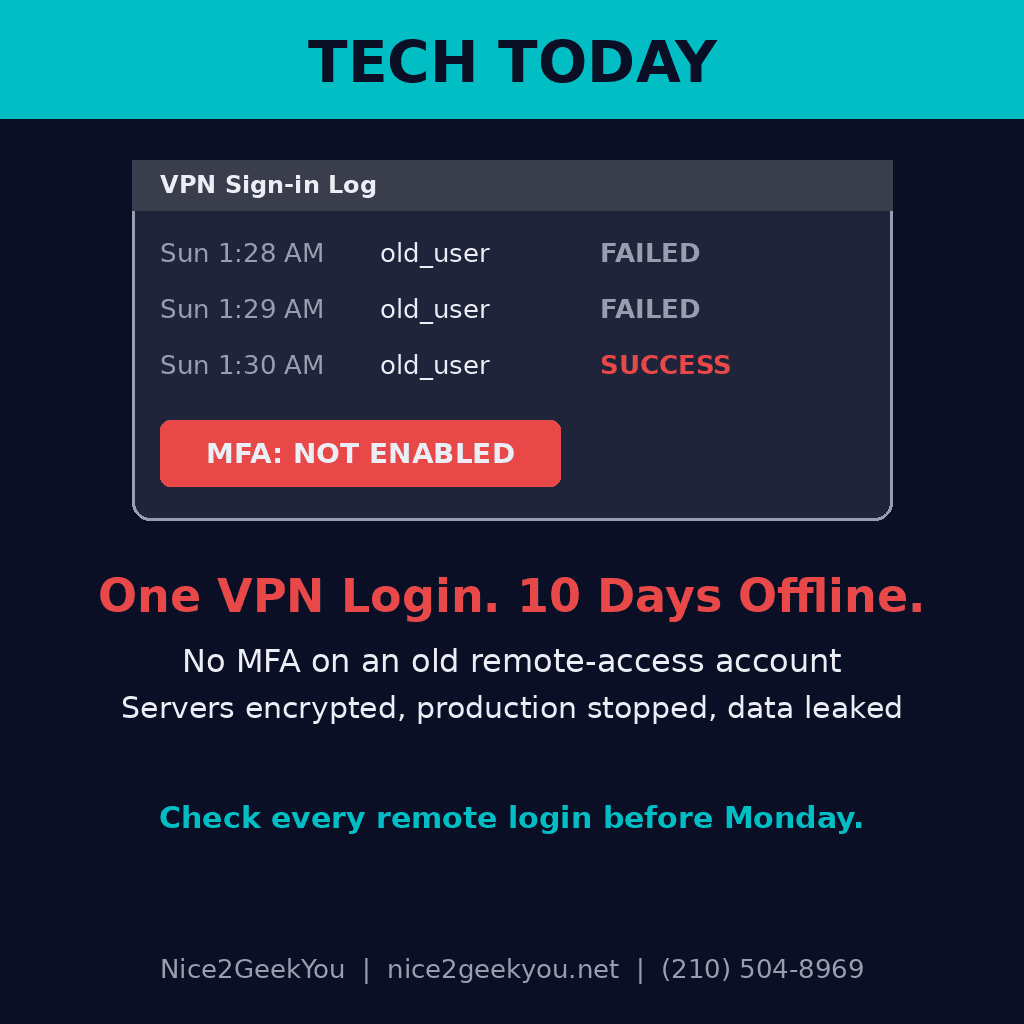
How much would ten days without production, shipping or new orders cost your business? Osaki Electric, a publicly traded Japanese maker of electricity meters, is finding out. The way in wasn't an exotic hack. It was a VPN login that didn't require a second step.
- The door: Osaki says the attacker got past the sign-in on the VPN device it uses for outside connections to the office network. It believes the attacker most likely got in by repeatedly guessing the password on an account that didn't have multifactor authentication (MFA) turned on. Some of those accounts were still in use.
- The timing: The break-in is estimated to have started around 1:30 a.m. on Sunday, November 15. Nobody noticed until Tuesday morning, November 17, when the company found its server data encrypted.
- The shutdown: By Tuesday afternoon Osaki had cut off its outside connections and shut down production systems. It plans to restart production in stages starting today, November 27, and will announce separately when shipments of existing orders and new orders resume.
- The data: On November 19 the company found its technical information posted on a website believed to be run by the attackers, and it has since confirmed data was sent out of its network. Access to a group company on the same network was also confirmed.
- It's not a one-off: Keio, a Tokyo railway group, says a September 26 ransomware attack took down the booking system for its Presso Inn hotels. It expects to lose about ¥1.8 billion in lodging revenue from October through December because the hotels haven't been able to take new bookings.
Why it matters for your money
Most small businesses have the same setup Osaki described: one remote-access door into the office network, whether that's a firewall VPN, remote desktop, or a remote-access app. Over the years it picks up accounts for former employees, vendors and "temporary" logins that never got MFA. Attackers know that, and they like to start on weekends and holidays, when nobody is watching the alerts. If they get in, the bill isn't just a ransom demand. It's the days you can't invoice, ship, schedule or book, plus cleanup and telling customers their data may be out.
What to check before Monday
- List every account that can use your VPN or remote access. Disable anyone who has left, every shared login, and any vendor account nobody can explain.
- Turn on MFA for every remaining remote login, with no exceptions. One account without it is enough, as Osaki found out.
- Lock out repeated password guesses. Make sure your firewall or VPN blocks or slows an account after several failed logins and alerts someone when it happens.
- Update the VPN or firewall firmware, and turn off remote-access features you don't actually use.
- Know who sees an alert at 1:30 a.m. on a Sunday. If the answer is "nobody until Tuesday," get after-hours monitoring in place and keep an offline backup you can restore from.
Nice2GeekYou is based in San Antonio, serving all of Texas on site, and our managed IT plans cover remote clients across the U.S., including firewall and VPN reviews, MFA setup and after-hours monitoring. Request a quote, see our monthly plans, or text us at (210) 504-8969.
Sources: Osaki Electric — Notice Concerning Suspension of Production Due to Ransomware Cyberattack (Second Report) (November 20, 2026); Osaki Electric — Third Report (November 25, 2026); Tokyo Brief — Keio expects ¥1.8bn hotel revenue hit as ransomware halts Presso Inn bookings (November 17, 2026).