
Texts Pretending to Be the IT Department Helped One Hacker Crew Steal $11.6 Million
A Scattered Spider leader was just sentenced to six years in U.S. prison. His crew texted employees while posing as their company or its IT provider, sent them to fake login pages, then used SIM swaps to take over accounts and steal more than $11.6 million. Here is how the trick works and the five things to set up this week so a single text can't cost you.
- smishing
- sim-swap
- scattered-spider
- phishing
- mfa
- help-desk
- social-engineering
- cybersecurity
- smb
- managed-it
- texas-it
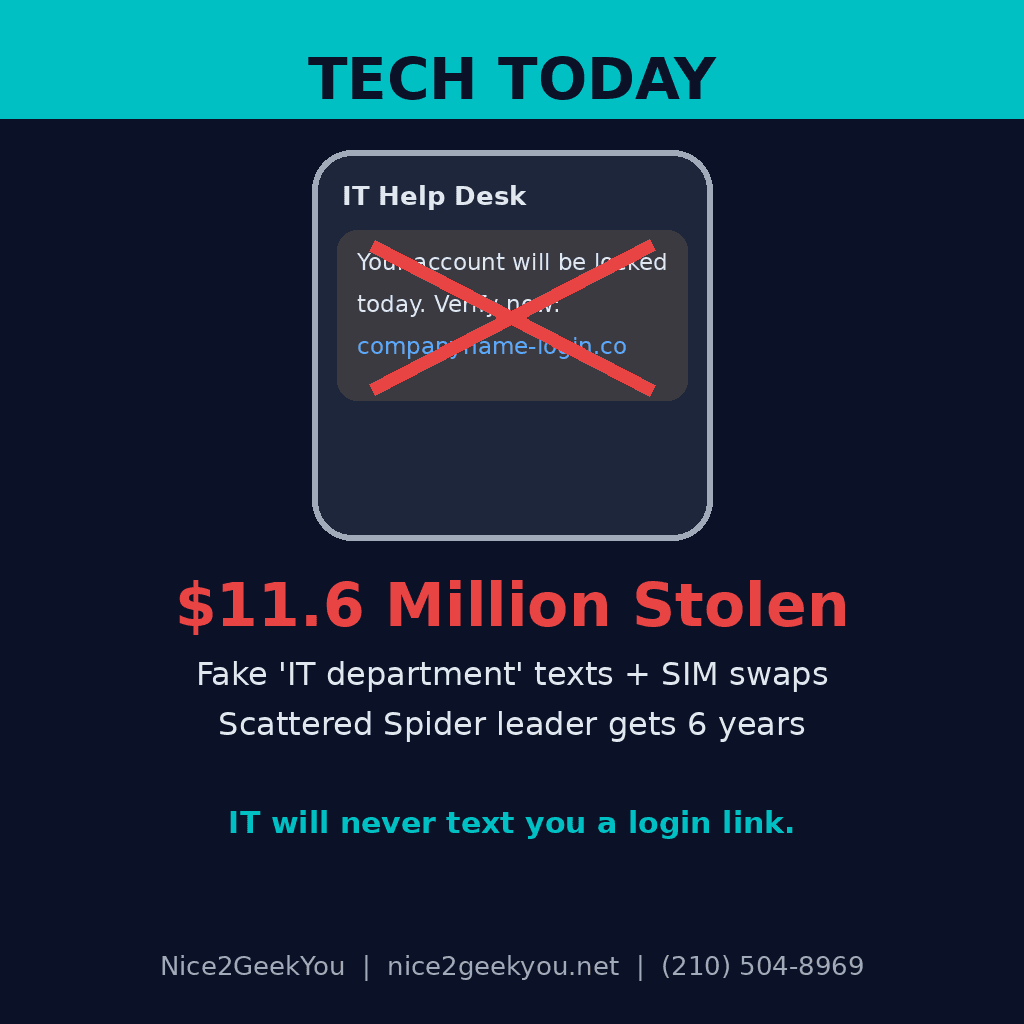
One text message that looks like it came from "IT" is all it took. On November 17, a federal judge sentenced Tyler Robert Buchanan, a 24-year-old British member of the Scattered Spider hacking crew, to six years in U.S. prison. Prosecutors say he and his partners stole at least $11.6 million in cryptocurrency and broke into about a dozen companies, starting with nothing more than text messages to employees' phones.
- The hook: the crew sent hundreds of text messages to employees while pretending to be their own company or a contracted IT or outsourcing provider, usually with an urgent reason to "log in now."
- The trap: the link went to a fake login page that looked like the employer's real website, and it captured usernames, passwords and personal details.
- The takeover: with that information, they pulled off SIM swaps, convincing a phone carrier to move a victim's number to a phone they controlled. From then on, every text-message login code went to the criminals.
- Who got hit: court records list telecom, tech, outsourcing, entertainment and IT supplier companies, plus individuals. The FBI says the group also uses MFA "fatigue" (flooding someone with sign-in prompts until they tap Approve) and has worked with ransomware gangs.
Why it matters for your money
Scattered Spider is famous for hitting big names like Caesars, MailChimp and Twilio, but the playbook is cheap and works on anyone: a believable text, a fake login page, and a phone number that can be hijacked. If your bank, payroll, email or accounting logins rely on a text-message code, a SIM swap can hand all of them to a stranger in an afternoon. Arrests don't end the threat, either. Other members are still active, and copycats use the same script.
What to do this week
- Tell your team the rule: our IT provider will never text you a login link. If a text says it's from IT, payroll or the bank, don't tap it. Call back on a number you already know.
- Move off text-message codes for email, banking and payroll. Use an authenticator app or, better, passkeys or a security key for owners, admins and anyone who moves money.
- Lock your phone numbers. Ask your carrier (AT&T, Verizon, T-Mobile and others) to turn on a number-lock or port-out PIN on every business line, especially the owner's.
- Never approve a sign-in prompt you didn't start. If prompts keep coming, report it right away. That's someone who already has the password.
- Set a call-back rule for money: any change to bank details, payroll deposits or a "send it now" request gets verified by phone before anyone pays.
Nice2GeekYou is based in San Antonio and serves all of Texas on site, and our managed IT plans cover remote clients across the U.S. We set up phishing-resistant sign-in, watch for risky logins, and train your team to spot fake "IT" texts before anyone taps. Request a quote, see our monthly plans, or text us at (210) 504-8969.
Sources: BleepingComputer — British Scattered Spider hacker sentenced to 6 years in prison (November 18, 2026); BBC News — British hacker who stole $11m jailed for six years in US (November 2026); Decrypt — Scattered Spider hacker sentenced to 6 years over $11.6M in stolen crypto (November 2026).