
Hackers Used GL.iNet's Cloud to Plant Malware on Routers and Remote KVMs. Check the Little Boxes on Your Network
GL.iNet confirmed that attackers exploited a flaw in its GoodCloud remote management service to install malware on some customers' routers and KVM devices, the small boxes many offices and remote workers use for travel Wi-Fi and to reach computers from anywhere. Researchers found reverse shells and older backdoors on some units. Here is what happened and the five things to do this week.
- gl-inet
- goodcloud
- router
- kvm
- remote-access
- malware
- firmware-update
- network-security
- remote-work
- msp
- cybersecurity
- smb
- managed-it
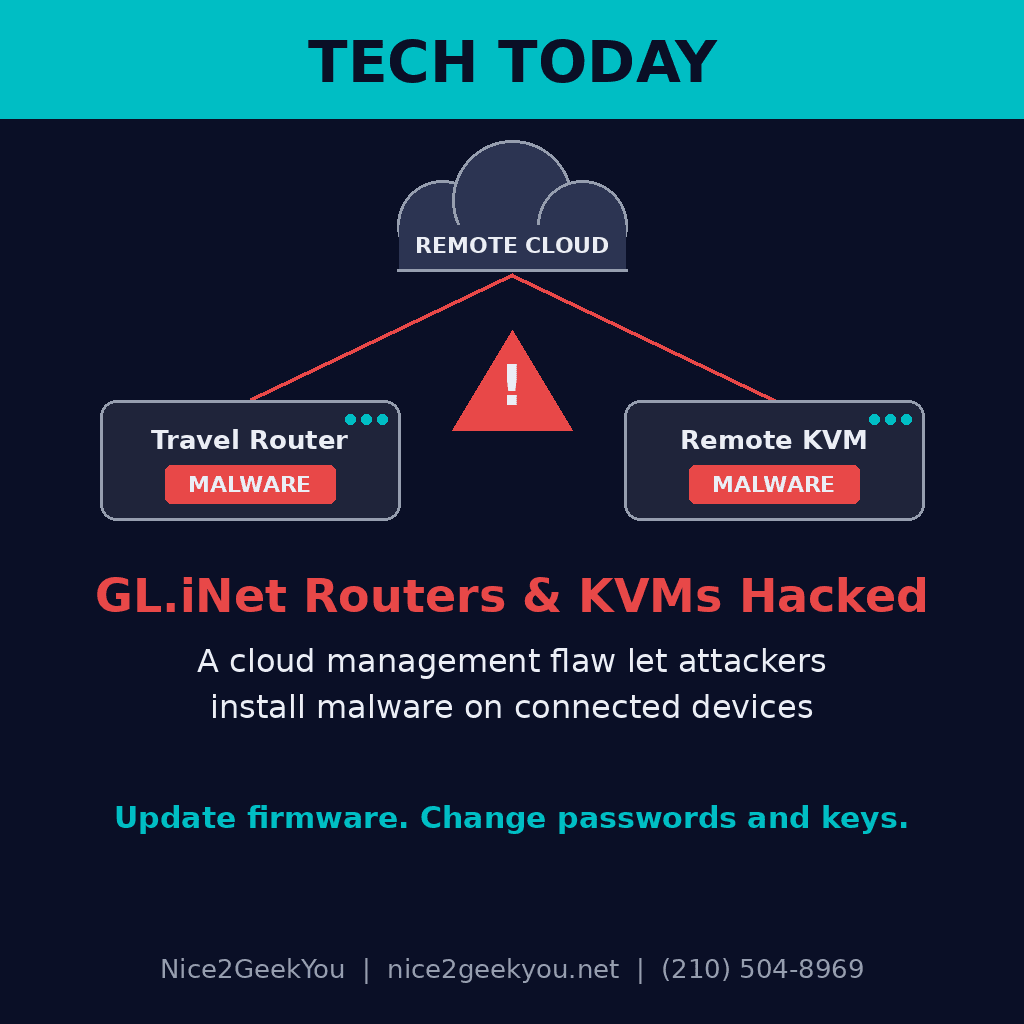
What could a stranger do with a box that sits between your office computer and the internet, or one that can type on that computer's keyboard from anywhere? That is the question GL.iNet customers are facing this week. On November 20, GL.iNet confirmed that an unauthorized party exploited a vulnerability in GoodCloud, its cloud remote management service, and installed malware on some customers' routers and KVM devices.
- What these devices are: GL.iNet makes home and travel routers that remote workers carry for hotel and client-site Wi-Fi, plus KVM-over-IP devices that let someone see and control a computer or server remotely, down to the keyboard, mouse and screen.
- What happened: GL.iNet says the flaw let messages be sent to other customers' cloud-connected devices without permission. It blocked the attack path on November 20 and released security firmware that removes the known malware. Its notice was updated on November 22 and 23.
- What researchers found: According to BleepingComputer, some owners reported backdoors and root-level reverse shells giving outsiders remote access. RemoteToHome Consulting said it checked 183 routers it owns or manages and found suspicious activity on 152, including 24 with root-level reverse shells and 47 with an older persistent backdoor that may not be linked to this attack.
- Hiding its tracks: BleepingComputer found the malware disguising itself as a normal system process, replacing a network tool so its connections didn't show, and adding SSH keys for remote access.
- What we don't know: GL.iNet hasn't said how many customers were affected or whether data was stolen, and it is still investigating whether computers attached to infected KVMs were compromised.
Why it matters for your money
A router or KVM is easy to forget because it just works. But whoever controls it can sit in the path of your traffic, and on a KVM, potentially reach the computer it's plugged into. If that's the machine that runs payroll, QuickBooks or your line-of-business software, an attacker with that kind of access is one step from your bank logins and customer data. GL.iNet is also clear that its cloud fix blocks new infections but doesn't remove malware already on a device or revoke passwords and keys that were already copied. Some malicious files had timestamps from December 2025, so a device that "seems fine" isn't proof of anything.
What to do this week
- Find the little boxes. Ask your team and your IT provider: "Do we have any GL.iNet routers, travel routers or remote KVMs, at the office or at anyone's home?" Include gear a remote employee bought on their own.
- Install the latest security firmware for the exact model. GL.iNet lists minimum versions on its security notice, for example 1.10.3 or later for most of its RM-series KVMs. Download it from GL.iNet's official site only.
- If a device was connected to GoodCloud, change its passwords and keys. GL.iNet recommends replacing the admin password and any VPN and SSH keys stored on the device, even if a check finds nothing.
- If anything looks off, reinstall clean. GL.iNet's strongest recovery option is installing the security firmware without keeping settings, then setting the device up again by hand. Don't restore an old backup from a device that may be compromised.
- Check the computer behind every KVM. Look for unfamiliar accounts, software, browser extensions or startup items and run a full security scan. Then decide whether that device needs cloud management at all, and turn it off if it doesn't.
Nice2GeekYou is based in San Antonio, serving all of Texas, and installs and manages business routers, firewalls, Wi-Fi and remote access gear on site. Our managed IT plans also cover remote clients across the U.S., including keeping network device firmware current. Request a quote, see our monthly plans, or text us at (210) 504-8969.
Sources: BleepingComputer — Hackers exploit GL.iNet cloud flaw to infect routers, KVM devices (November 22, 2026); GL.iNet Security Notice: GoodCloud Remote Management Incident (issued November 20, updated November 23, 2026); RemoteToHome — GL.iNet security incident technical breakdown (updated November 22, 2026).