
Black Friday Scams Are Landing in Work Inboxes. One Fake Delivery Email Can Cost Your Business More Than a Bad Deal
Shopping-season phishing is already surging: KnowBe4 saw 82% more Black Friday phishing in the first week of November than in all of October, and Check Point found more than 4,000 new sale-related domains, nearly one in five already flagged as risky. Scammers are aiming at employees on company email and devices. Here is what to watch for and the five things to do before the long weekend.
- black-friday
- cyber-monday
- phishing
- delivery-scam
- email-security
- security-awareness
- mfa
- holiday-scams
- msp
- cybersecurity
- smb
- managed-it
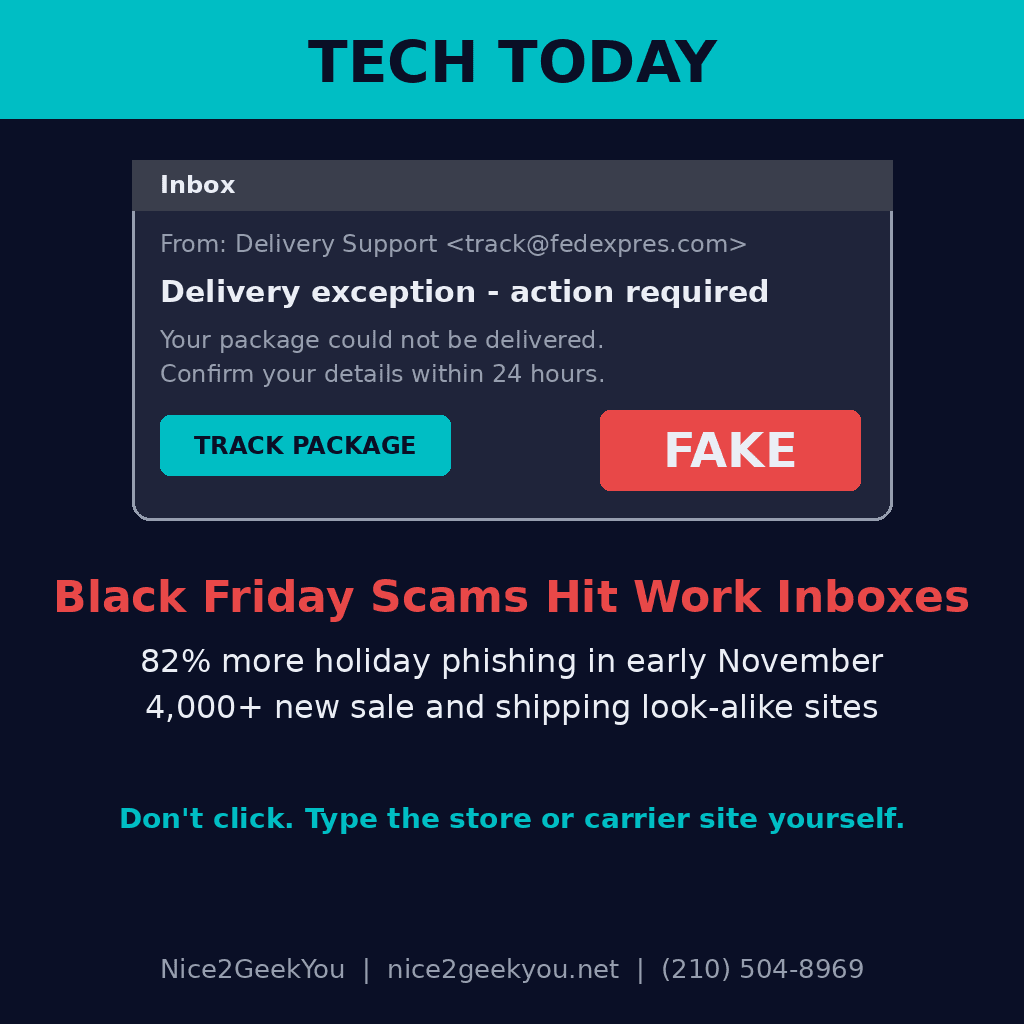
What happens when someone on your team clicks a "delivery exception" email on a work laptop while tracking a holiday order? If it's one of this season's fakes, the scammer doesn't just get a shopper's card number. They can get a password that opens your business email, your files, or your bank portal. And this year the fakes started early and are arriving fast.
- The volume is up sharply: KnowBe4's Threat Lab says the first week of November alone had 82% more Black Friday phishing than the whole of October. It spotted the first Black Friday lure on October 20.
- They're aiming at work inboxes: KnowBe4 says criminals are deliberately targeting shoppers through their corporate email, counting on distracted employees on company networks and devices. Manufacturing, healthcare, government and education were the most targeted industries.
- Thousands of look-alike websites: Check Point Research found more than 4,000 newly registered domains tied to November sales, big retailers and shipping companies in October and early November, and nearly one in five was already classified as risky.
- Fake tracking pages: Check Point counted 647 new domains built on the pattern "fedex" plus a few extra letters between September and November 8, and found at least one showing a fake FedEx package-tracking page.
- Attacks on retailers are climbing too: Organizations in consumer goods and retail averaged 2,458 cyberattacks per week in September and October, up 28% from earlier in the year, according to Check Point.
Why it matters for your money
The three lures KnowBe4 flags most are fake discount offers that harvest payment details, fake parcel-tracking and "delivery exception" notices from Amazon, Walmart and the big couriers, and fake alerts claiming an unauthorized charge or a suspended account that "needs re-verification." The last two look just like normal business mail, and that's the problem. If an employee types their work password into one of those pages, an attacker can read invoices, change payment instructions, and send convincing requests to your customers and vendors from a real company account. One compromised device can open the door to the whole business. The long Thanksgiving weekend is also when fewer people are watching for strange logins.
What to do before the long weekend
- Send your team a two-line heads-up today. "Expect fake delivery, refund and 'suspicious charge' emails and texts this week. Don't click; go to the store or carrier site yourself."
- Track packages the safe way. Type the retailer's or carrier's address into the browser, or use their app. Never use the link in an unexpected email or text, even if it has a real-looking tracking number.
- Turn on multifactor sign-in everywhere that matters. Email, Microsoft 365 or Google Workspace, banking, payroll and accounting. A stolen password alone shouldn't be enough to get in.
- Make reporting easy. Give everyone one place to forward anything suspicious, and thank people who use it. Fast reports let you block a bad link before the next person clicks.
- Double-check any payment change by phone. If a vendor or "bank" asks you to update payment details or pay with gift cards, wire or debit, call a number you already have on file before money moves.
Nice2GeekYou is based in San Antonio, serving all of Texas on site, and our managed IT plans cover remote clients across the U.S., including email filtering, multifactor setup and staff phishing training. Request a quote, see our monthly plans, or text us at (210) 504-8969.
Sources: KnowBe4 — Black Friday phishing rises 82% in early November (November 19, 2026); Check Point Research — Black Friday Cyber Crime 2026: Attacks on Retailers Surge 28% as Risky Domains Multiply (November 16, 2026).